Thursday, September 15, 2011

America's Persevering Promoters of Our Glorious Revolution


One of the reasons people left their homes in Europe in the early 1600's was to escape religious persecution. In 1620, the Mayflower sailed to the New World and established Plymouth, Massachusetts. Unfortunately, their desire to worship as they desired blinded them from granting the same freedom to others. This same scenario seemed to be repeated throughout the early New World and Colonial America.
Many religions fled to the New World, as did Baptist.
Many falsely report that the first Baptist church in America was started by Roger Williams in Rhode Island. This is NOT the case. Let us examine the man Roger Williams.
He came to America in 1631, settling in Massachusetts. He was a libertarian and was forced to separate from the Puritans. He did found the colony of Providence, Rhode Island, and was a notable figure in our nation's history. We are concerned in this writing as to Baptist history, and unfortunately, Roger Williams was not a Baptist. While Roger Williams did believe in immersion, he did not see the need for proper baptism and felt one could baptize themselves (SE-Baptism). He did start a church in Rhode Island in 1639, but it was not the first Baptist church in America. In 1897, the historical committee of the First Baptist Church of Providence voted to change their starting date to 1638 in order to be the first baptist church in America. Unfortunately for them, they cannot change the date on the church bell that still resides there that reads 1639.
The first Baptist church in America was at Newport, Rhode Island, established in 1638 by Dr. John Clarke. Clarke was a Baptist from London, England. Clarke was forbidden to preach in Boston, and took a small group of believers to Newport in 1638 and established the first Baptist church in America.
This author will not go into detail, but suggests the reader research and read the rich Baptist history in the American early colonies. Scores of books and biographies could be written about the great Baptist men in those days. Men like John Clarke, Obadiah Holmes, Isaac Backus, Thomas Dungan, Samuel Harris, Daniel Marshall, Shubael Stearns, John Waller, John Gano, and the like. To these men and the multitudes unnamed, we Baptist and all of America owe a great debt. For over 100 years, Baptist were persecuted, whipped, imprisoned, and even martyred for preaching Truth on early America's land. It was Baptist who continually cried out for liberty-the freedom to worship God as their conscience demanded. The Catholics, Episcopals, Quakers and such wanted a state to enforce that all worshipped as they did, but it was Baptist that cried for liberty and separation of church and state (what that term truly means). Their cry for religious freedom would also lead towards a cry for political freedom.
It was the heavy Baptist populated Rhode Island that was the first colony to renounce allegiance to King George III. It was Baptist who were one of the first groups to recognize the Continental Congress as a legitimate body of government. The Baptist of both early America and England supported the War for Independence.
It was a Baptist pastor in Charleston, South Carolina that was so influential in speaking out against the British. He was banned from Charleston, but his influence continued. The British general, Lord Cornwallis said of him:
I fear the prayers of that godly youth more than the armies of Sumter and Marion.

Baptist played a huge role in the War for Independence. They furthered the cause in crying out for liberty both civil and religious. Baptists have never been 'gunslingers,' (only resorting to taking up arms when necessary), but some did join the continental army and many Baptist pastors served as chaplains. George Washington said of these men:
Baptist Chaplains were among the most prominent and useful in the army.

Many of our nations 'Founding Fathers' have Baptist ties and influence. Consider the following:
Patrick Henry This man was a great friend to Baptist. In 1770, three Baptist preachers were arrested in Fredericksburg, VA for preaching the Gospel. It was Patrick Henry that rode 60 miles to volunteer to be their lawyer. By the time Henry was done speaking, the judge declared, "Sheriff, discharge these men." Religious liberty was growing! For the rest of his years, Henry was a friend of Baptist only needing to be notified of their peril, and soon he rode to defend them.
James Madison This man was greatly influenced by the Baptist. It was the Baptist that helped get him elected to House of Representatives where he would campaign for the Bill of Rights. Known as the "Father of the Bill of Rights," it is no coincident that Right number one reads
Congress shall make no law respecting an establishment of religion or prohibiting the free exercise thereof.
Why is that the first amendment? ONLY THE BAPTIST were crying out for such liberty at that time, and we see their influence reflected immediately. What joy must have been amongst Baptists to read those words of guarantee! Madison often declared that the Baptists had been in all his time ,"the fast and firm friends of liberty."
Thomas Jefferson This man was not a Baptist and held to Unitarian beliefs. His life's actions have been much in question, yet the Baptists looked to him as a friend. Why? Thomas Jefferson lived near to a Baptist Church. Many times he would visit that church. Once, after a business meeting of the Baptist church, the pastor asked Jefferson what he thought of the democratic form of government displayed. Jefferson responded,
It interests me much. I consider it the only form of true democracy now existing in the world, and have concluded it would be the best form for the government of these American colonies.
Jefferson was hated by the New England clergy, who spread much gossip about him leaving us today to wonder where he really stood. This we know, he stood for religious freedom, soul liberty, which made him a friend of the Baptists; and possibly, much of our democratic government was influenced by his time observing the Baptists.
George Washington President Washington was also influenced by the Baptists. Washington, in a letter in 1789, wrote:
Baptists have always defended the principles of religious liberty, they have never violated them...The little Baptist state of Rhode Island was the experiment first attempted of leaving religion wholly to herself, unprotected and unsustained by the civil arm. The principles which were here first planted have taken root...and borne abundant fruit.

This Giant in American history is recognized by most for kneeling in the snow at Valley Forge speaking to our God. The records at First Baptist Church of New York City give the account of George Washington's baptism. After the war, but while still in camp at Newburg, on the Hudson River, George Washington approached the Baptist pastor John Gano. Gano, pastor at the First Baptist Church in New York, was serving as chaplain in the army. The account goes on to read that General Washington, having listened to Gano and searching the Scriptures, requested baptism as taught in the Scriptures. There in the Hudson River, with 42 witnesses, Gen. Washington surrendered to Scriptural baptism. It was George Washington that wrote to the Baptists in Virginia:
The religious society of which you are members, have been throughout America, uniformly and almost unanimously, the firm friends to civil liberty, and the persevering promoters of our glorious revolution, I cannot hesitate to believe, that they will be faithful supporters of a free, yet efficient, General Government. Under this pleasing expectation, I rejoice to assure them, that they may rely upon my best wishes and endeavors to advance their prosperity.

Monday, August 29, 2011

Jolly Old History


Baptist had been active before, during, and after the Reformation throughout all of Europe and England. Time does not allow to exhaustively study great Baptist such as Franciscus Van Der Back in Italy (drowned for the faith in 1564 by Catholics), Peter Weidman in Hungary, Peter Gonesius in Poland, French Flanders in France, and Jonann Oncken in Germany. We will instead focus on the British Isles.
As previously noted, New Testament doctrine came to England during the time of the apostles. It continued on through the preaching of Baptist men such as St. Patrick in the 5th century. Around the year 1000 A.D., the Paulicians entered England, followed by a Waldensian named Walter Lollard which brought great revival in the 12th century. It was this revival and people that had a tremendous influence on Wycliffe who adopted many of their views. William Tyndale's parents were members of the Baptist church in Abergaverney, Wales.
Around the time of the Reformation, the Baptist in England were forced into hiding due to the persecution of Catholics. Kings such as Henry VIII persecuted, arrested, and martyred many Baptists for their faith. In 1533, Henry VIII ordered Baptist to leave the country within 12 days or face the stake. There were 3 different occasions that monarchs issued Acts of Pardon (1538, 1540, 1550) forgiving prisoners and convicts. Each time, Baptist were excluded from the pardon while thieves, robbers, and vagabonds went free. The death penalty was enacted for reading Baptist books. (see Hammet, "History of Baptist").
England would see the rise of men such as John Smyth. John Smyth was not the founder of English Baptist as we have so clearly seen, but he was a man who stood for religious liberty. Smyth would question what is Scriptural baptism and eventually baptized himself in hopes of obtaining it. Thomas Helwys broke away from Smyth over succession, Jesus not being God, and civil concerns. Helwys would in England in 1612 found a church in Spitalfields which he called Baptist (though he was not holding to what Baptist teach). He did teach against Calvinism and predestination, but believed men could lose their salvation. His church became known as the General Baptist Church. He would die in prison calling for religious freedom.
There was another group of Baptist that arose in that time known as the Particular Baptist. They Particular Baptist held to Calvinism that Christ had died for only particular people. The first Particular church was founded around 1635. They did see the necessity of Scriptural baptism and sent a man, Richard Blunt, all the way to Holland to get Scripturally baptized and sent back to baptize their church Scripturally. Some prominent Particular Baptist are as follows: John Milton, John Bunyan, John Gill, Andrew Fuller, William Carey, and Charles Spurgeon.
There was another group that arose called Regular Baptist who opposed both General and Particular Baptist.
Under the Weslyan revivals, the Baptist saw a great increase in England. Many of the converts from these revivals studied Scripture and were baptized as baptist. In 1800, it is estimated that there were no more than 150,000 Baptists and 708 churches in England. By 1901, there were 2,771 churches and a Baptist membership of 435,000.
In 1891, the Baptist Union began as the General and Particular Baptist joined together. This is due to the fact that the Unitarians were withdrawing from the General Baptists, and Calvinism was refuted by the Weslyan revivals and missionary work. This union brought with it a rise in the false teaching of Open Communion.
A study of Baptist history will soon change focus to a new land, America; but the contributions of the English Baptist were indeed great as they brought to the world: a call for religious liberty, a movement towards missions, Sunday Schools (not Robert Raikes, but William Fox at Prescott Street Baptist Church), Bible Society, and great hymn writers.
Our next study will focus on America's Baptist heritage, but we would be amiss to ignore the Baptist influence at this time in Australia and New Zealand. It is true that Baptist were the last of the 'denominations' to begin work in Australia, but this is primarily due to the fact that there were no Baptist convicts. The first recorded Baptist service was held in Sydney on April 24, 1831.

Tuesday, August 23, 2011

Praise the Lord

Wednesday, August 10, 2011

ReThinking ReFormers


As we approach the year 1500 and the close of the Dark Ages, we are confronted with a time period known as the Reformation. A time when reformers were helping "give the modern age a model of spiritual freedom....the chains of the Middle Ages snapped as Luther declared...reform in the church...inspire others to take a stand for the Word of God....set loose the true spirit of individual liberty." At least that is what we all learned in our A Beka books on world history (quotes taken from World History and Cultures 10th grade.) This same book goes onto to say that "Beginning about 1525 there arose a group of Protestants...called Anabaptists...today are called Baptist." WHAT? Then what have we been studying all along? It's no wonder our Baptist young people have no idea of their heritage as Baptists when WE are teaching them this junk! The Protestant Reformers "gave a model of spiritual freedom?" The reformers "stood on the Word of God?" The Reformers set loose the true spirit of individual liberty?" The Baptist began in 1525?
I think it is time we Re-Think the Re-Formers.
The papacy was loosing its strangle hold on Europe around this time. There was the "Babylonian Captivity" when the papacy was moved to France in the 1300's. Then the "Great Schism" of the papacy in the 1400s when there was actually 3 popes. The people were starting to see the failures and lies of the papacy, and this opened the door fresh thought. Men arose who started preaching some differences than what the Catholic church held. Then again, as we have seen, there have always been men preaching differences and holding to the Truth and suffering for it at the hands of the Catholic church. So why do we praise these Reformers? Were they standing for truth?
John WycliffeWycliffe in his early days accepted the papacy, but later saw their error and declared the pope to be Antichrist. He denied transubstantiation and insisted upon the authority of Scripture. He is referred to as the "Morning star of the Reformation." He preached against the worldliness of the clergy, auricular confession, veneration of images, and other Catholic dogmas. He is best known for his translation of the Bible into English. Problem is, he used Jerome's Latin Vulgate to translate from. The Vulgate was a corrupt text based on Origen's text. The Wycliffe Bible omits many of the same Scriptures modern corrupt texts omit. Some hold that Wycliffe's Bible was pure...I suppose the jury is still out-for some. Wycliffe unfortunately still practiced infant baptism. Wycliffe, in this author's opinion was on the right tract. There were some errors he held to, and should we have lived in that time most certainly could have found a more Biblical people to join with.
John Huss Huss was ordained a Catholic priests in 1400. He too condemned the papal authority. He still held to the Catholic teaching of an universal church comprised of all the saved. Many of his followers joined with the Waldenses. Huss did take a good stand on what were catholic errors. He was a firery preacher who stood against the papacy who he called the "successor of Judas Iscariot." The Hussites were hated by the papacy and persecuted and martyred for their faith. In 1457 many of his followers separated from their own church for "a more Biblical way and joined with the Waldenses." (Hammet "The History of Baptist")
Jerome Savonarola He is referred to as a great reformer in Italy. Unfortunately, while he did call for moral reforms, he never separated from the false teachings of the catholic church. He held to their theology, sacraments, transubstantiation, Mary worship, etc. This author can find no proof for any doctrinal praise for Savonarola.
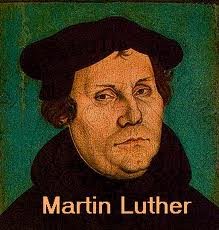
Martin Luther Ah, Martin Luther. The 'hero' for most protestants (and A Beka books). Let us rethink this reformer as well. Luther became a Catholic priests in 1507, but by 1517 posted his 95 Theses on the doors of the church at Wittenburg. He would be excommunicated by the pope, found the Lutheran faith, and officially begin the Protestant Reformation. BUT...he believed in antinomianism (liberty of grace equals license to sin). We read in our school text books how he "came to realize that man is saved not by his own works but by faith in the finished work of Christ on the cross. At last, Martin Luther understood God's mercy, grace, and love; he found salvation." (World History and Cultures 10th grade A Beka). Did he really? The Bible teaches "Wherefore by their fruits ye shall know them." Matt. 7:20. Let us examine Luther's fruits. Luther taught that a Christian is not under any moral law except that imposed by secular authority. His own life was one of obscene language, heavy drinking, and condoning of concubines and bigamy (Albert Newman "A Manual for Church History). Luther hated the 'anabaptist,' condemning them even to martyrdom. Luther said "Thou owest God nothing save to believe and confess. In all things else he gives thee absolute freedom to do as thou wilt without any peril of conscience." Luther would hold to baptismal regeneration saying "(getting saved) is not done by any law or works but by a new birth, and by renewing of the inward man, which is done in baptism." (Martin Luther "Commentary on Galatians"). So, Luther believed God's grace = a license to sin, no moral law for a man, wicked talk, drinking, lasciviousness, hated and martyred our Baptist forefathers, and held to baptismal regeneration. And we are supposed to praise him? We are supposed to think him a saved man? Luther's god is not the same God I serve (sorry David Cloud-please note I am not against David Cloud's stand on many issues, but that statement he made is wrong). Luther needed to be saved and is no hero or lover of the Word of God.
Ulrich Zwingli Switzerland's reformer who condemned purgatory, worship of saints, the papacy, transubstantiation, mass, etc; but he did not join with our forefathers, rather drowned and burnt them for our faith. Zwingli held to infant baptism despite his 'reforms'.
John Calvin The 'Reformed' reformer. A Frenchman who would lead the 'French Reformation.' He did not seek to reform the church, but rather to start a new one. He believed the church and state should be governed by Scriptures. Calvin defended infant baptism and baptismal regeneration. His theology is corrupt. He taught an invisible 'church' with a 'visible church' within made up of all believers. He was not a friend of baptist and persecuted them often. Calvinism has done great harm to the cause of Christ and doctrine. The 'reformed movement' of today is a direct result of his heresies. Calvin should not be venerated as a hero.
John Knox He also persecuted and martyred our forefathers and held to many of Calvin's heresies. He would be known as the founder of the Presbyterian church and no friend to the Baptists.
So, according to our Abeka history books, these men gave: "the modern age a model of spiritual freedom....the chains of the Middle Ages snapped as Luther declared...reform in the church...inspire others to take a stand for the Word of God....set loose the true spirit of individual liberty."
After ReThinking it, who gave a model for spiritual freedom? Most of these men murdered and persecuted those who held to the Word of God as we do. Who inspired others to take a stand for the Word of God with their infant baptism, baptismal regeneration, license to sin preaching? Who set loose the true spirit of individual liberty with their threats and forcing to adhere to their beliefs or face the drowning waters or firery stake?
I think it is time we Re-Think the Re-Formers and start studying and appreciating those who held to Truth!
Now on mobile

Tuesday, July 19, 2011

A Reason, Request, and a Release

Yes, I am still alive! I did not mean to take half the summer off from writing, but the Lord knew and is in charge. I thought I would just 'check-in' and write a few thoughts I need to share.

1. A Reason
The reason I have not written is because of an illness. Unfortunately, it is not an illness of mine own, but my wife's. She has been sick since the last week of May and we have been under a doctor's care all the while. We are not out of the woods yet, but she is getting better. I believe it to be from a physical fatigue and a spiritual attack. I want to thank my church for being so gracious throughout this time. What a blessing to part of our church. My lack of writing has been due to the time and care required of me for my wife. Nothing on this earth is of more importance to me than her, and I am trying to do what I know the Lord would have me to do.

2. A Request I would ask that all who can, to continue to pray for my wife as she recovers and strengthens. I thank all those who already have been praying, and ask you to continue doing so. Also, please pray for my children and our church that the Lord would keep His protecting arm around each. Satan would love to use these times to get his foot in the door and cause havoc. I covet your prayers.

3. A Release I want to issue a formal 'press release' to all readers. I invite you to attend our Baptist Conference this Monday-Thursday (July 25-28th). There will be many guests preachers/missionaries and families joining us. Services begin each night at 7:00 p.m. Please consider joining us. All pastors/missionaries and their families are also invited to a dinner in our fellowship hall at 5:45 each evening. Please let me know if you can attend so preparations can be made. If you cannot come, please pray for the meetings that the Lord would use them in a mighty way.

Friday, July 15, 2011

Yes, This Really Happened To Me In The Ministry

The great commission was given to the church to go into all the world and preach the gospel. Of course the gospel is the death, burial and resurrection of the Lord Jesus and if you believe it you are saved. The commission was not given to the apostles only or it would have ended when the last one died. It was not given to the individual because part of the commandment is to baptize and that is the responsibility of the church.
The Bible tells us to bear fruit as a christian. We must bear fruit for the sake of the lost and also that we may be blessed and know the joy that comes from seeing a soul trust Christ as their Saviour. Dan. 12:3 says, "And they that be wise shall shine as the brightness of the firmament; and they that turn many to righteousness as the stars for ever and ever."
Many today do not participate in soul-winning or door-to-door visitation. They omit this blessed part of the christian's life for varied reasons. Some are afraid of rejection. That happens for sure. Some are afraid they will knock on the door of a "mean" person. This too happens though not nearly as frequently as most imagine. Some even go so far as to say this is old-fashioned and ineffective. Regardless of the excuses it is still our obligation. Do not get me wrong, I do not think you ever get over the butterflies every time you approach a new door.
I miss being able to physically visit as I have for over 40 years. To me it was an adventure. While serving in Miami Fl. I remember one particular day of visitation.
We had with us at the time a family I had attended Bible college with who had surrendered to the mission field. On Saturday we divided up and went soul-winning. I took the missionary with me and the senior pastor took the bus pastor with him. Our plan was to go around the block in separate directions and meet on the other side. As we were nearing the other side I did not see the other team. We walked on a porch and knocked. A gruff voice from inside shouted "Who is it?" I identified myself and asked if we could talk with him. He said no and told us to get off his porch! I even asked if we could just leave him some material to read. Again he said no and get off his porch. I turned to the missionary and said we had tried and began to leave. Then I decided I was not going to let the devil and a grouch get the best of me. I knocked again. Again the man asked who it was. I repeated our introduction and said I was not going to leave until he at least opened the door and took the material.
All of a sudden the door opened violently and there in our faces was the barrel of a gun! I was shocked. The missionary grabbed me and pushed me to the front as a shield (what a friend!) After a moment we heard laughter coming from the inside of the house. It was the pastor and bus director. It so happened this was the home of a friend of the pastor. Needless to say we were both relieved and nervous. I still have not lived down that visit.
Do not make excuses or neglect witnessing. It is always an adventure and we are told that we "...shall doubtless come again with rejoicing, bringing his sheaves with him."